
By Sophia Charchalou
Matriculation now lies some six weeks behind us. I remember the excitement of that early-morning start, eager to present the best version of ourselves for a photograph that would, many years later, become a reminder of where we began. The people you were nestled between might have been strangers at the time, but later they would become familiar faces and friends, individuals who were part of the same story.
To be ‘non-gowned’ is to possess the freedom to decide whether or not to wear the gown: an opportunity for students to place themselves at the centre of the “organic” transformation of tradition shaped over generations
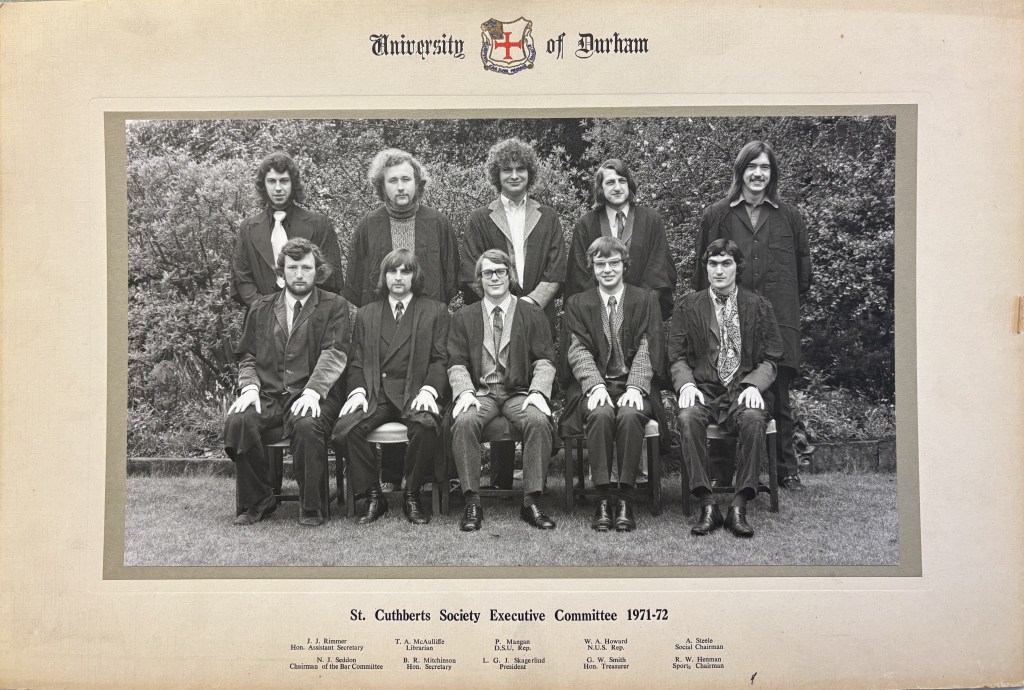
My 2023 matriculation photo now hangs on the wall of 12 South Bailey, alongside more recent portraits and some dating back to the first decade of the twentieth century. Together, these photos tell the story of Cuth’s. They capture the faces of those who have shaped the Society and the visual symbols through which its history and traditions have been preserved. Looking between the frames, it is possible to trace our college’s story: 1900, the St Cuthbert’s Committee and its fight for recognition beyond the collegiate system; 1946, the Era of the Refounders and Tom Percival’s efforts to resurrect the Society after World War Two; 1971, Leslie Brooks and his Executive Committee, marking the expansion of Cuth’s along the Bailey. These are names familiar to us for good reason: they belong to individuals and events that helped shape the student experience we know today and are consequently celebrated for it.
Among the traditions carried through these generations is sartorial: that of wearing the academic gown. For Cuth’s, in particular, the gown is something that holds more significance than simply being part of Durham’s academic dress. In 1888, when a collection of local and mature students sought an identity beyond being ‘Unattached’ from the traditional colleges of Hatfield Hall and University College, and then again for the first women to be granted full admission to the college in 1969, academic dress offered a visual expression of university membership, despite their challenges to Durham conventions and the backlash they faced as a result. At Cuth’s, the dynamics of belonging have been far from straightforward and have continued to evolve across the decades.
“I wear a gown because I earned it”
Our principal, Dr Matthew Mills, offers further clarity on the regulations surrounding the gown. Many students, both new and old, assume that the ‘non-gowned’ identity of Cuth’s represents an outright rejection of academic dress, a narrative which Mills disputes. He suggests that the Society’s unofficial motto, ‘traditionally untraditional’, could be taken as a rejection of simple binaries: a means of holding in tension the traditions of one of Durham’s oldest ‘colleges’ and the unconventional circumstances of its student-founded origins. In the modern context, Mills rejects the classification of Cuth’s as a ‘non-gowned’ college, but rather, advocates for the power of decision to sit with individual students, who may choose to embrace a tradition practiced since the Society’s earliest days. This freedom is reflected in the Society’s formal dress code, which invites guests to wear black academic gowns and cultural dress. Both reflect Cuth’s celebration of identity, whether cultural or academic. To be ‘non-gowned’, Mills says, is to possess the freedom to decide whether or not to wear the gown: an opportunity for students to place themselves at the centre of the “organic” transformation of tradition shaped over generations.
Mills’ appreciation of the gown has a personal dimension. Having grown up in Northumberland and being the first member of his family to attend university, he recalls how academic dress came to represent a sense of academic achievement and belonging. As Mills puts it, “I wear the gown because I earned it”. Reflecting on his undergraduate experience at Oxford, he described an environment in which it would have been possible to feel alienated by his surroundings, at least at first. Yet, in an interesting reversal of the assumptions often attached to academic dress, the gown offered a means of transcending distinctions between himself and his peers, since it literally covered over the distinctions in clothing which are taken as symbols of affluence in so many contexts. Rather than reinforcing elitism, the gown was a symbol of equality: something earned through academic endeavour, regardless of background.
The gown’s place at St Cuthbert’s Society has everything to do with what it means to belong. The freedom to embrace academic dress pays tribute to the expressions of student identity long before us, while allowing successive generations to shape the traditions they inherit in their own way. The gown also carries a sense of continuity throughout academic life, from the first experience of university to the graduation ceremony, when the addition of a hood marks the culmination of one’s academic journey. As another generation of matriculation photographs find their place on the walls, perhaps the gown deserves to be a part of them.






Leave a Reply